Online Journal Poltekkes Kemenkes Malang
Journals
-
NUTRITURE JOURNAL
NUTRITURE JOURNAL is an open access and peer-reviewed journal published three times a year (April, August and December) by the Nutrition Department of the Health Polytechnic, Ministry of Health, Malang. This journal contains research articles in the field of nutrition and health, with aspects of clinical nutrition, nutritional biochemistry, community nutrition, sports nutrition, food service management, functional food, as well as pharmaceutical and food analysis.
-
Jurnal Keperawatan Terapan
ANNOUNCEMENT
Important Updates for Authors, Reviewers, and Readers (Effective for Volume 12, 2026)
We would like to inform all authors, reviewers, and readers that Jurnal Keperawatan Terapan has implemented several important updates.
1. Changes to the Editorial Board and Reviewer Team
The Editorial Board and Reviewer Team have been updated. The latest list of editors and reviewers can be accessed through the Editorial Team and Reviewer Team menus on our website.
2. Changes to the Journal Scope
The scope of Jurnal Keperawatan Terapan has been revised and clarified to provide a stronger focus on applied nursing and evidence-based nursing practice. Authors are encouraged to ensure that their manuscripts align with the updated scope, which can be found in the Focus and Scope section.
3. Updated Template and Author Guidelines
Authors are required to use the latest article template before submitting their manuscripts. The updated template and author guidelines are available in the Article Template section of the journal website.
4. Language Requirement for Volume 12 Number 2 (September 2026)
Starting from Volume 12 Number 2 (September 2026), all submitted and published articles must be written in English. Authors are requested to prepare their manuscripts accordingly and ensure compliance with the journal's language requirements.
5. Additional Information
Accreditation: Indexed in SINTA 4
Article Processing Charge (APC): IDR 500,000 per accepted article, in accordance with Director Decree no. KU.01.01/F.XIII/6021/2026 dated July, 08 2026 since Volume 12 no. 2 September 2026
Publication Schedule for Volume 12:
- March 2026
- September 2026
We kindly encourage all authors and prospective authors to carefully review these updates before submitting their manuscripts. Thank you for your attention and continued support of Jurnal Keperawatan Terapan.
-----------------------------------------------------------------------------------------------------------------------------------------------------------
Jurnal Keperawatan Terapan is the official publication of Poltekkes Kemenkes Malang which contains articles of research results in the field of Applied Nursing. Jurnal Keperawatan Terapan is published twice a year, in March and September. For writers who want to publish their work in Jurnal Keperawatan Terapan is free of charge. If the author has difficulties to submit his work in this journal please contact admin (see contact support).
Registration and article submission guidelines can be downloaded here
-
Jurnal Informasi Kesehatan Indonesia (JIKI)
Jurnal Informasi Kesehatan Indonesia (JIKI) is a journal to disseminate various scientific papers on health development and other research of health also disseminate the conceptual thoughts or ideas and research results that have been achieved in area of health applied. JIKI particularly focuses on the main problems in the health development areas as follows Medical Records, Management Information, Health Insurance, Health Policy and any Specifics Issues of Public Health. Publish 2 times a year, May and November. There is no charge for submitted manuscripts. All manuscripts should be sent to the Editor of Journal Informasi Kesehatan Indonesia through the Online Submission in this address http://ojs.poltekkes-malang.ac.id/index.php/JIKI. If authors have problems while sending the manuscripts online, please contact the Editor at the email jurnal@poltekkes-malang.ac.id
INDEXING AND ABSTRACTING
Jurnal Informasi Kesehatan Indonesia (JIKI) has been covered by the following services:
-
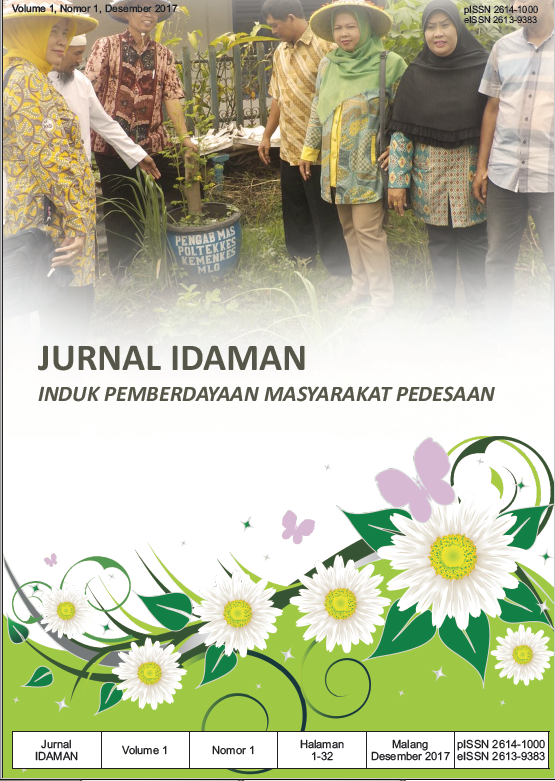
Jurnal IDAMAN (Induk Pemberdayaan Masyarakat Pedesaan)
Jurnal IDAMAN (Induk Pemberdayaan Masyarakat Pedesaan) adalah publikasi resmi dari Politeknik Kesehatan Kemenkes Malang yang memberi wadah untuk mempublikasikan hasil Pengabdian Masyarakat yang merupakan salah satu Tri Dharma Perguruan Tinggi, karya ini juga melalui proses kajian ilmiah sehingga mampu menjadi acuan untuk data pendukung suatu penelitian.
Jurnal IDAMAN (Induk Pemberdayaan Masyarakat Pedesaan) juga menerima artikel berupa telaah dari kegiatan Pengabmas dari luar institusi, Informasi lebih lanjut harap menghubungi Unit Publikasi Ilmiah Poltekkes Kemenkes Malang.
Jurnal ini terbit 2 (Dua) kali setahun April dan Oktober
-
Malang Journal of Midwifery (MAJORY)
Malang Journal of Midwifery (MAJORY) is an open access journal (e-journal) which publishes the scientific works for health practitioners and researchers. The focus and scopes of the journal include maternal and neonatal health. The journal is published twice a year in April and October. Submitted papers can be written in Indonesian for initial review stage by editors and further review process by minimum two reviewers. The MAJORY Editorial team welcome and invite researchers from around the world to submit their papers (original research article, systematic review, and case study) for publication in this journal. All papers are published as soon as they have been accepted..
-
Journal of Local Therapy
Journal of Local Therapy (JLT)
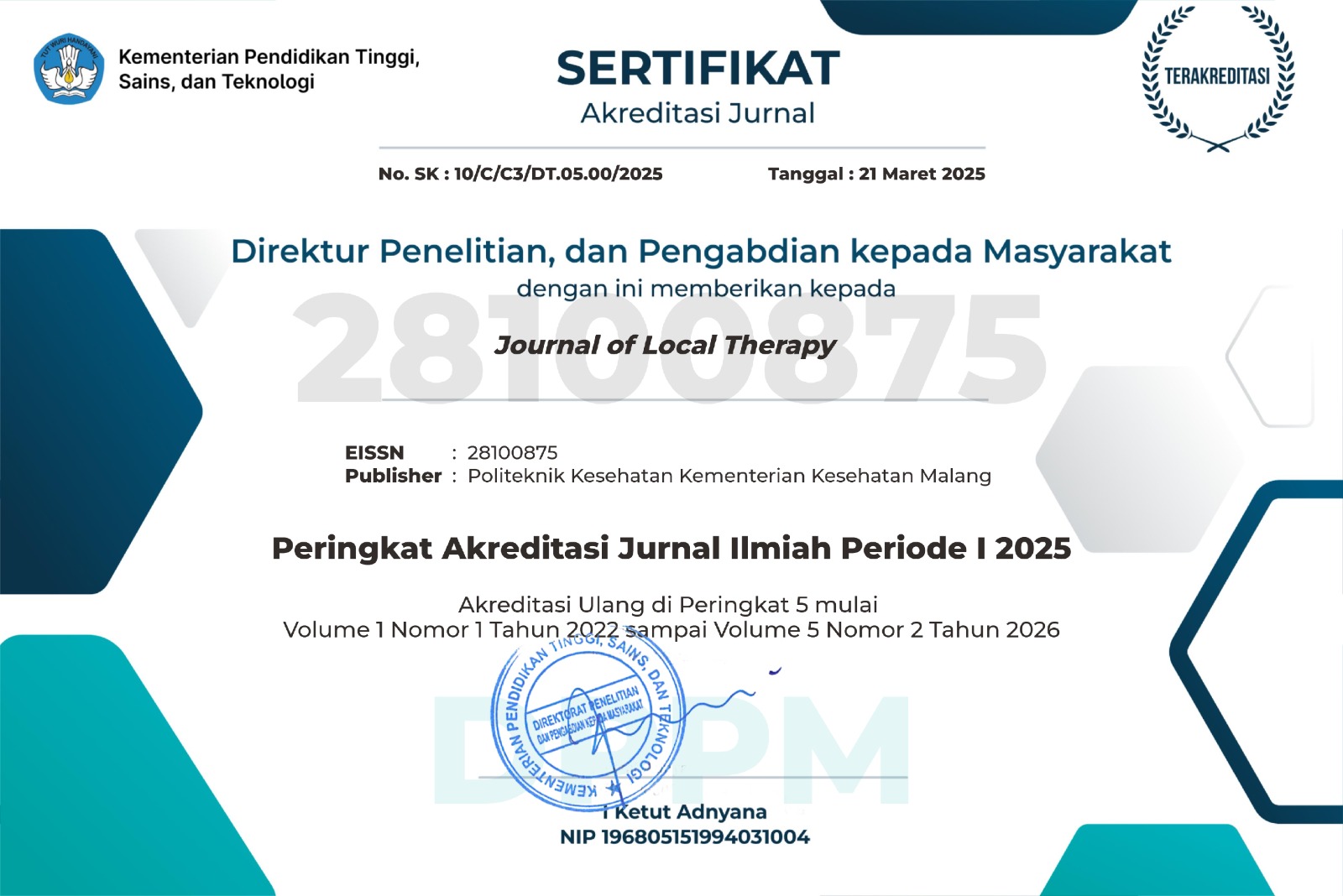
E-ISSN: 2810-0875 | P-ISSN: 2809-3240
Citedness in Google Scholar | Dimensions
Journal of Local Therapy (JLT) is a peer-reviewed and open-access journal published by Politeknik Kesehatan Kementrian Kesehatan Malang. Starting from 2026, the journal is published twice a year in April and October.
Journal of Local Therapy (JLT) is a scientific journal that publishes original research articles, review articles, case reports, special articles, and illustrative articles focusing on local and traditional health therapies. The journal serves as a medium for disseminating scientific findings, conceptual ideas, and applied research results in the field of health development, particularly those related to local wisdom and traditional practices.
JAI is accredited in SINTA (Science and Technology Index) at grade 5 by the Ministry of Research and Technology of the Republic of Indonesia (Kementerian Riset dan Teknologi Republik Indonesia), Decree (SK) No. 10/C/C3/DT.05.00/2025 valid from Volume 1 No 1 (2022) to Volume 5 No 2 (2026)..
Please make sure that your article follows the author guidelines and submission template.

Editor in Chief >> Editorial Team
Nur Rahman
Universitas Muhammadiyah Yogyakarta, Indonesia
Academic profile:


Submission to the first decision
Peer-review duration
8 weeks
4–8 weeks
Authors benefit:
Open access — free access for all readers.
Continuous publication — accepted articles are published promptly.
Reasonable APC — details here.
-
Jurnal Pendidikan Kesehatan
P-ISSN 2301-4024 | E-ISSN 2442-7993
Jurnal Pendidikan Kesehatan (e-journal) is a journal to disseminate various scientific papers on health development and other research of health also disseminate the conceptual thoughts or ideas and research results that have been achieved in the area of health applied.
JPK particularly focuses on the main problems in the health development areas as follows:
*) Nurse
*) Midwifery
*) Nutrition
*) Food Analyse
*) Any specifics issues of public health
Journal History
Starting from Vol. 14 No. 1 (2025) Jurnal Pendidikan Kesehatan (e-Journal) use a new layout template
-
Health Access Journal
Health Access Journal This journal is an International media for the publication of articles on research, literature review, book review, commentary, opinion, perspective, scientific news and letter to editor in the areas of health science and practice such as public health, environmental health, nursing, midwifery, nutrition, health technology, health education, health information system, health management, and health popular. -
Indonesian Journal of Health Insurance and Medical Records (IJHIMR)
Indonesian Journal of Health Insurance and Medical Records (IJHIMR) is a scientific journal that disseminates various papers in the forms of literature reviews and original articles with a focus on management information systems, medical records, health insurance, health financing, health policy, and other issues related to social security. This publication is issued twice a year (March and October) and accepts original articles and literature reviews. There is no charge for the manuscript sent. All manuscripts must be sent to the Editor of the Indonesian Health Information Journal through the Online Submission at this journal website. If the author has problems when sending the manuscript online, please contact the Editor.
-
Indonesian Journal of Applied Health
Indonesian Journal of Applied Health (IJAH) is a publication that contains scientific articles related to health sciences. This journal is used by researchers, academics, health practitioners, and students to access and share the latest knowledge and findings in the field of health sciences covering various topics such as nutrition, epidemiology, pathology, pharmacology, nutrition, public health, environmental health, medicine, nursing, and other knowledge about the world of health. This journal accepts articles in Indonesian and English.
-
Jember Maternal and Child Health Journal
Jember Maternal and Child Health Journal This journal is published by Politeknik Kesehatan Kemenkes Prodi Jember. Offers an exclusive forum for advancing scientific and professional knowledge of the maternal and child health field. Peer-reviewed papers address maternal and child practice, policy, and research, exploring such topics as maternal and child epidemiology, demography, and health status assessment. Exploring the full spectrum of the field, Jember Maternal and Child Health Journal is an important tool for practitioners as well as academics in public health, obstetrics, gynecology, prenatal medicine, pediatrics, and neonatology. This journal is published twice a year in May and November, e-ISSN : 3063-3710
-
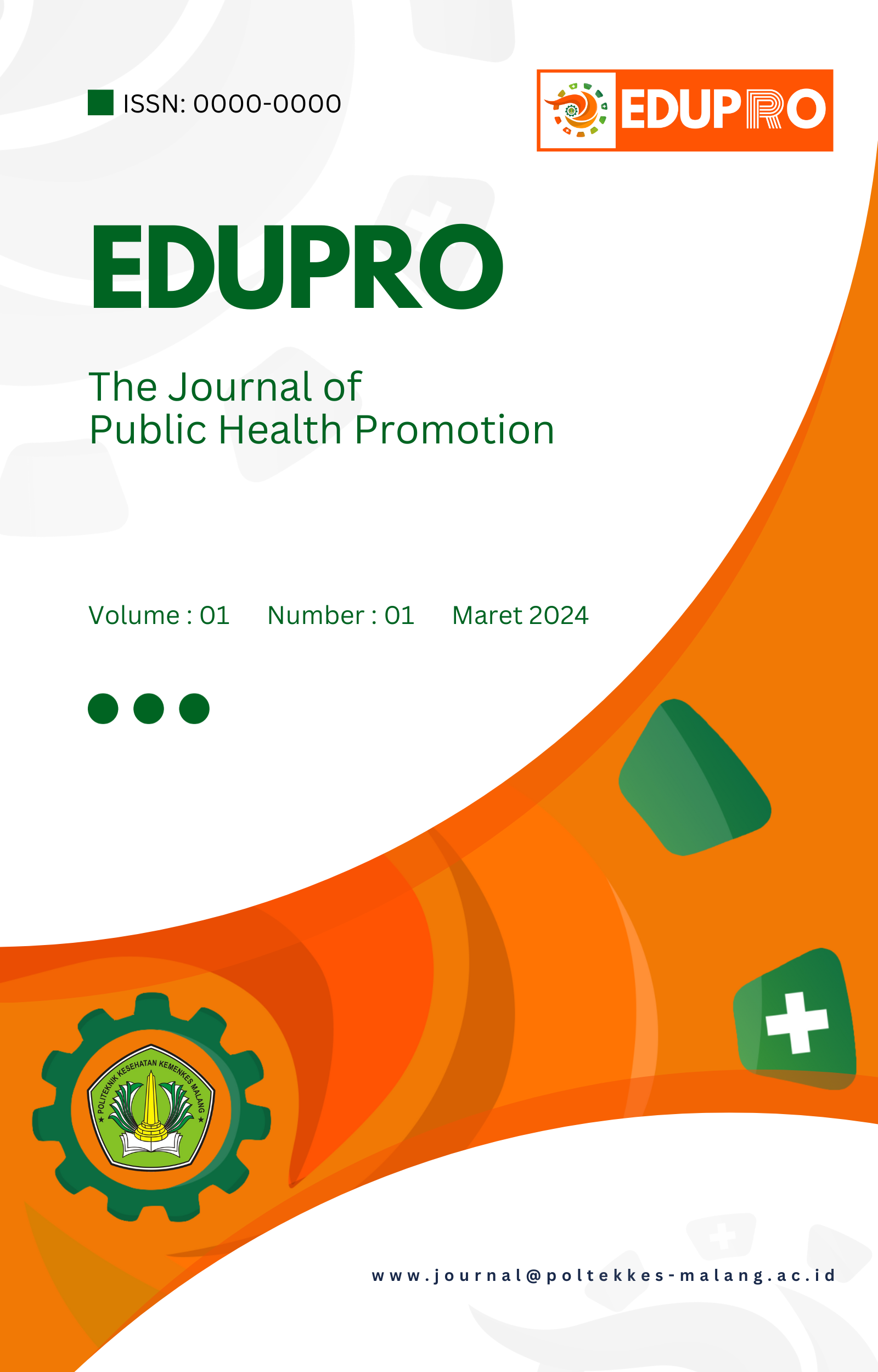
The Journal of Public Health Promotion
Welcome to the Journal of Public Health and Health Promotion, this journal serves as a dynamic platform for all health practitioners, scholars, and policy makers who aim to advance the well-being of individuals, groups and communities. The scope and focus of our journal is to explore a broad spectrum of topics related to public health and health promotion fields such as strategic activities, interventions and innovations in public health and health promotion. We hope that our journal can contribute to the improvement of health globally and as a whole.
-
Health and Scientific Journal
Health and Scientific Journal is an open-access, peer-reviewed journal. Our main goal is to disseminate current and original research articles from academics, researchers, and practitioners in the fields of health sciences, particularly midwifery, medicine, nursing, and public health sciences. This journal provides free access to all published content for readers worldwide, supporting the broad dissemination of knowledge. The journal is published twice a year, in March and September by Kampus 4 Prodi Kebidanan Kediri Poltekkes Kemenkes Malang. E-ISSN: 3164-6638
-
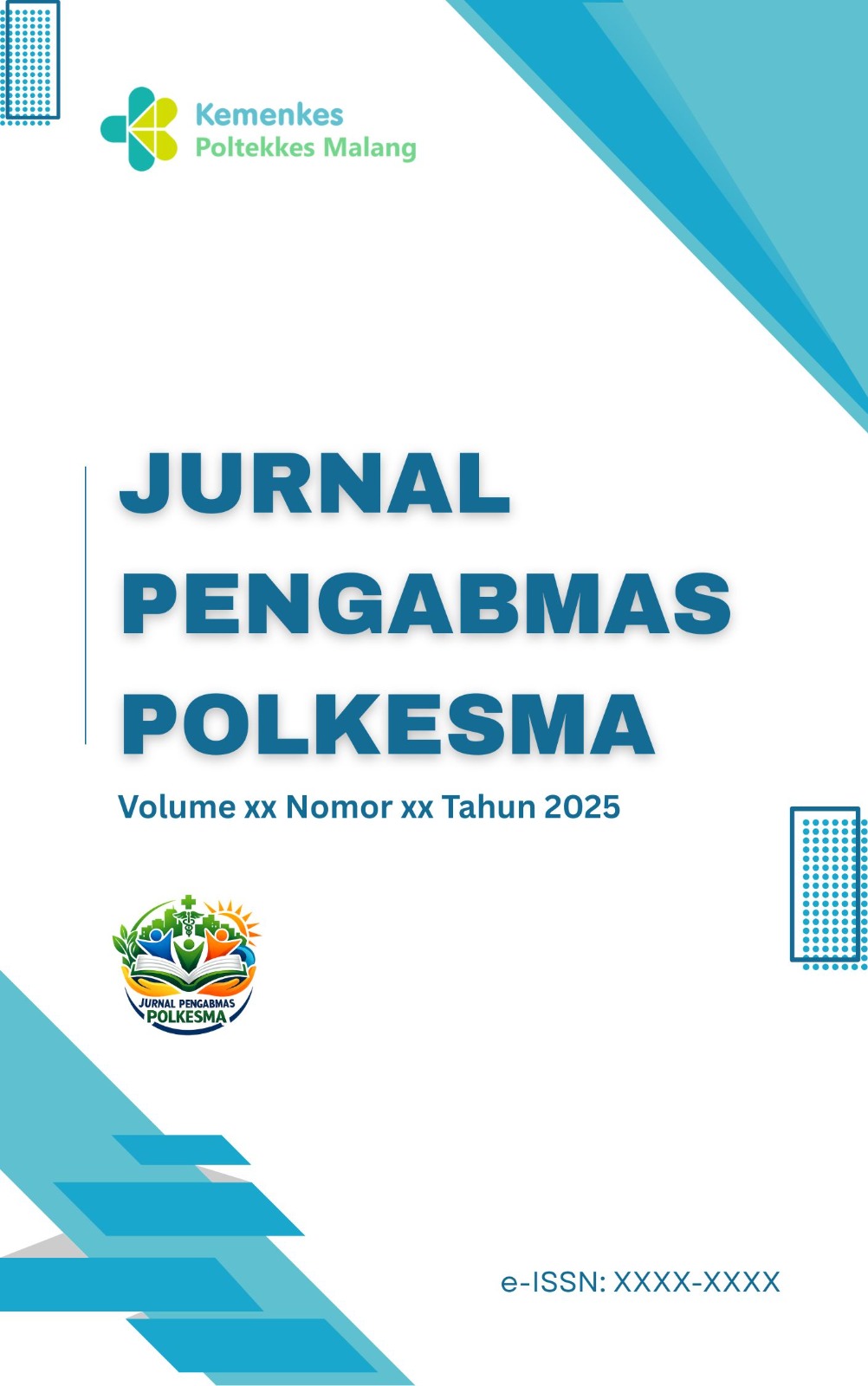
Jurnal Pengabmas Polkesma
Jurnal Pengabmas Polkesma adalah publikasi resmi dari Politeknik Kesehatan Kemenkes Malang yang memberi wadah untuk mempublikasikan hasil Pengabdian Masyarakat yang merupakan salah satu Tri Dharma Perguruan Tinggi, karya ini juga melalui proses kajian ilmiah sehingga mampu menjadi acuan untuk data pendukung suatu penelitian.
Jurnal Pengabmas Polkesma juga menerima artikel berupa telaah dari kegiatan Pengabmas dari luar institusi, Informasi lebih lanjut harap menghubungi Pusat Penelitian dan Pengabmas Poltekkes Kemenkes Malang.
Jurnal ini terbit 4 (empat) kali setahun Maret, Juni, September dan Oktober.